

INSTITUTIONAL RELEVANCE
Lifecycle-Separated Interoperability Across
Independently Governed Environments
Supporting continuity, interoperability, and institutional readability while preserving independent authority and operational responsibility.
Architecture for an Increasingly Interconnected Financial System
Financial infrastructure is evolving across banking, payments, payment-stablecoin environments operating under applicable law, digital assets, securities, derivatives, custody, clearing, collateral, identity, compliance-related information, and continuously available markets.
As these environments become more interconnected, institutions increasingly need information to remain understandable across systems and organizational boundaries without transferring the legal authority or operational responsibility attached to that information.
VeloxVFX presents lifecycle-separated informational architecture concepts directed to this structural problem. The objective is not to combine independently governed functions into a single operating authority. The objective is to support structured coordination while preserving institutional boundaries.
Why Lifecycle Separation May Matter
A financial lifecycle may involve multiple institutions, systems, decision points, legal regimes, and operational states. Those functions may interact, but they are not interchangeable.
Lifecycle-separated architecture provides a conceptual method for preserving those distinctions so relevant information may remain attributable, reviewable, reconstructable, and interoperable across heterogeneous environments.
Identity is not authorization.
Authorization is not execution.
Custody is not settlement.
Audit is not supervision.
Continuity is not control.
Representation is not authority.Potential Relevance to Financial Institutions
For banks, credit unions, custodians, clearing organizations, market intermediaries, infrastructure providers, and other regulated or independently governed institutions, lifecycle-separated architecture may support clearer representation of changing conditions without displacing the institution responsible for acting on them.
Depending on the applicable environment, the architecture may describe representations of:
customer, member, counterparty, intermediary, and institutional relationship states;
externally established authorization, eligibility, review, and exception conditions;
transaction, instruction, reporting, correction, and continuity states;
custody, release-condition, collateral, margin, and externally governed reserve- and redemption-related references;
audit, remediation, evidence-lineage, and reconstructability information; and
transition and continuity conditions across systems or organizational change.
These are architecture-oriented representations. They do not independently establish the underlying legal, operational, supervisory, or institutional condition.
Potential Relevance to Financial Markets
Developments across securities and derivatives markets illustrate the importance of coordination among independently governed trading, clearing, collateral, margin, custody, reporting, and settlement environments.
Lifecycle separation may help preserve distinctions among product state, transaction state, collateral state, margin state, reporting state, exception state, and continuity state. The underlying trading, clearing, settlement, legal, and supervisory responsibilities remain with the authorized institutions and public authorities responsible for them.
Continuous Markets and Operational Readiness
Continuously available markets introduce an important distinction: continuous technical availability is not necessarily continuous institutional or market readiness.
Liquidity, collateral availability, payment continuity, surveillance, exception handling, human review, operational dependencies, disruption response, and recovery conditions may be governed by different institutions and infrastructure at different times.
Lifecycle-separated representation may support clearer visibility into those changing conditions without making the architecture the market operator, regulator, settlement system, or source of institutional authorization.
Potential Relevance Across Sectors
Banking and Payments
Clearer separation among account, authorization, payment, liquidity, exception, reporting, and continuity conditions.
Securities and Derivatives
Structured representation of product, transaction, collateral, margin, reporting, and lifecycle information across independently governed market infrastructures.
Custody and Asset Environments
Custody-support and release-condition representation without assuming possession, asset control, or release authority.
Digital Assets and Payment Stablecoins
Representation of issuer, relationship, externally governed reserve and redemption references, transaction, eligibility, reporting, and continuity conditions while legally operative responsibilities remain external.
Public-Authority-Facing Environments
Continuity, externally governed authorization context, reviewability, and audit-oriented representation without transferring sovereign, supervisory, regulatory, enforcement, sanctions, or monetary authority.
Institutional Value
The potential value of lifecycle-separated architecture lies in preserving clarity rather than centralizing control. It may support more distinguishable, attributable, reviewable, reconstructable, interoperable, auditable, and resilient information across exceptions, transitions, and institutional boundaries.
The institution responsible for a legally operative decision remains responsible for that decision. Architecture may support understanding around the decision; it does not become the decision-maker.
Institutional Boundary Preservation
The following matrix illustrates how lifecycle-separated information may remain reviewable across independently governed environments while legal authority, operational responsibility, supervision, custody, settlement, and decision-making remain with the appropriate institutions.
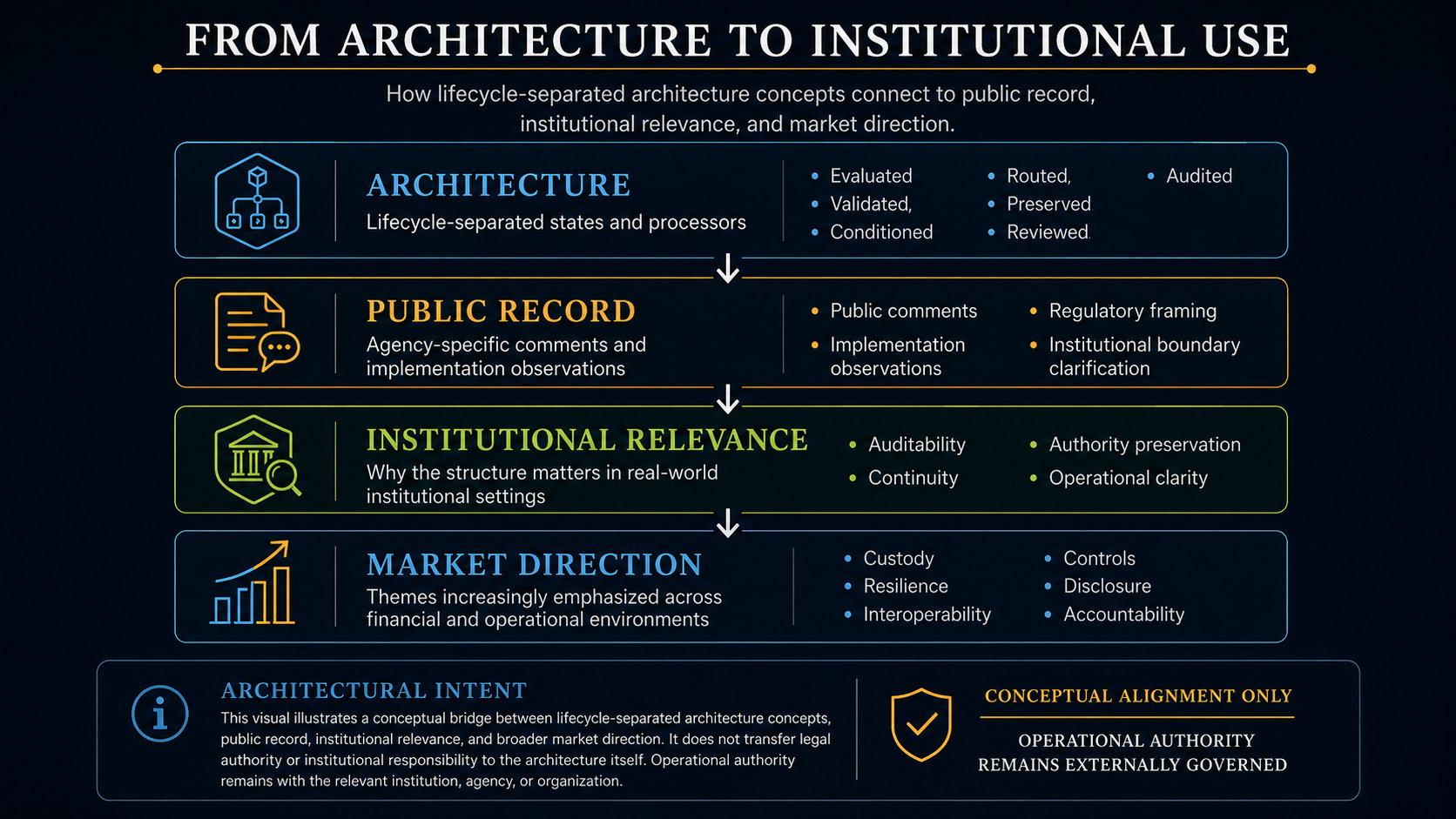
This matrix illustrates conceptual architecture relationships only. It does not represent agency or institutional adoption, endorsement, implementation, operational integration, or transfer of authority.
Architecture Rather Than Operation
VeloxVFX presents informational, interoperability-oriented, and continuity-oriented architecture concepts. VeloxVFX is not a bank, financial institution, payment processor, money transmitter, custodian, settlement operator, stablecoin issuer, exchange, broker, governmental authority, regulatory authority, supervisory authority, enforcement authority, sanctions authority, or sovereign monetary authority.
The architecture does not independently determine identity, legal eligibility, compliance, sanctions status, product classification, jurisdiction, transaction approval, custody, settlement, or governmental outcomes. Those responsibilities remain with independently authorized organizations acting within their respective authority and applicable law.
Closing Principle
Connected markets do not require collapsed responsibilities.
VeloxVFX presents lifecycle-separated informational architecture concepts for environments in which information may need to move across institutional boundaries while legal authority, operational responsibility, supervisory jurisdiction, and governmental authority remain independently governed.
Structured coordination, not consolidation.
Information may interoperate; authority remains attributable.
Boundary Statement
VeloxVFX LLC presents lifecycle-separated informational architecture concepts. VeloxVFX LLC is not a bank, financial institution, payment processor, money transmitter, settlement operator, custodian, stablecoin issuer, exchange, broker, governmental authority, regulatory authority, supervisory authority, enforcement authority, sanctions authority, or sovereign monetary authority.
The architecture does not independently execute transactions, control assets, determine identity, establish eligibility, make compliance determinations, or determine legal or regulatory outcomes. All legally operative decisions, execution, settlement, custody, compliance determinations, and governmental functions remain with independently authorized organizations acting within their respective authority.
Potential relevance does not imply adoption, implementation, affiliation, endorsement, approval, institutional integration, or operational use.