

ARCHITECTURAL FRAMEWORKS
Lifecycle-Separated Interoperability Architecture Families
Across Commercial, Supervisory, Government-Facing, Custody-Support, Transaction-Environment, and Continuity Domains
The VeloxVFX framework is organized as a collection of lifecycle-separated interoperability architecture families. Each family is presented as a distinct conceptual domain developed around continuity-oriented architecture, structured interoperability, supervisory readability, institutional-boundary preservation, and independently governed responsibilities.
* Framework descriptions are presented for informational, educational, and architecture-oriented purposes only.
GENERAL INTELLECTUAL-PROPERTY AND OPERATIONAL BOUNDARY
References to pending patent applications, trademark filings, public-record materials, or framework identities reflect ongoing intellectual-property development and should not be interpreted as operational financial services, institutional affiliation, government or agency adoption, regulatory approval, deployment, custody, settlement, payment processing, money transmission, stablecoin issuance, private-equity participation, financial-instrument status, or independently governed operational control.
01 — COMMERCIAL-DOMAIN FAMILY
VeloxFX™
Lifecycle-Separated Commercial-Domain Interoperability Architecture
VeloxFX™ presents commercial-domain infrastructure architecture organized around separately bounded routing, validation, parameter conditioning, infrastructure evaluation, recovery and replay, audit-oriented traceability, and commercial instruction-state generation.
Each function remains confined to its own lifecycle role. The architecture supports structured coordination and state readability across independently governed environments without combining distinct functions into a single decision-making or execution authority.
Framework Components
VeloxFX™
Commercial-Domain Lifecycle-Separated Interoperability Architecture
A commercial-domain framework for structured interoperability, transaction-state coordination, lifecycle separation, and institutional-boundary preservation across independently governed environments.
VeloxFX Black Box™
Infrastructure-State Readability and Audit-Oriented Observability
A separately bounded framework component supporting infrastructure-state visibility, reviewable lifecycle records, operational-boundary readability, and audit-oriented traceability without supervision, enforcement, or institutional control.
Official Trademark Records
VeloxFX™
U.S. Trademark Application Serial No. 99298794
VeloxFX Black Box™
U.S. Trademark Application Serial No. 99391858
VeloxFX Black Box™
U.S. Trademark Application Serial No. 99379422
Patent Architecture Continuity
U.S. Patent Application No. 19/273,585
Routing-Oriented Coordination Architecture
Represents pathway-identification and routing-oriented transaction states within a separately bounded lifecycle function. Routing identifies a represented pathway; it does not determine validity, establish eligibility, authorize execution, process payment, transmit money, or conduct settlement.
U.S. Patent Application No. 19/278,835
Validation-Oriented State Review Architecture
Represents validation-oriented review states for externally supplied transaction information. Validation-state review does not determine identity, establish legal eligibility, originate authorization, select a routing pathway, execute a transaction, or make a legally operative compliance determination.
U.S. Patent Application No. 19/281,658
Parameter-Conditioning Architecture
Represents externally supplied parameters, conditions, constraints, and boundary states within a separately bounded lifecycle function. Parameter conditioning does not establish policy, create legal requirements, originate authority, validate a transaction, select a pathway, or perform institutional execution.
U.S. Patent Application No. 19/289,063
Infrastructure-Evaluation and Scoring Architecture
Represents infrastructure-related evaluation, scoring, observability, and assessment states. Evaluation supports architecture readability; it does not route transactions, determine legal compliance, supervise institutions, enforce requirements, authorize execution, or control infrastructure.
U.S. Patent Application No. 19/292,060
Recovery and Replay Architecture
Represents post-event recovery, replay, reconstruction, and continuity-oriented states. Recovery and replay support reviewable lifecycle continuity; they do not reverse legally operative transactions, alter settlement finality, control institutional records, or exercise remediation authority.
U.S. Patent Application No. 19/328,192
Audit-Oriented Traceability and Disclosure Architecture
Represents reviewable lifecycle records, structured state history, traceability, and disclosure-oriented information. Audit-oriented representation does not perform an audit, make compliance determinations, supervise institutions, compel disclosure, exercise enforcement authority, or replace official records.
U.S. Patent Application No. 19/276,946
Commercial-Domain Instruction-State Generation and Execution-Status Processing Architecture
Represents bounded commercial instruction-state generation and execution-status processing. The architecture does not perform legally operative transaction execution, payment processing, money transmission, custody, settlement, or finality. All downstream execution and legally operative action remain external to the represented architecture and under the authority of independently authorized organizations.
Related Architecture Layers
Routing-Oriented Coordination
Transaction-state pathway identification without validation, authorization, payment processing, or settlement.
Validation-Oriented State Review
Representation of validation-related review states without identity determination, legal judgment, or execution authority.
Parameter Conditioning
Representation of externally governed parameters, conditions, and boundaries without policy creation or authorization.
Infrastructure Evaluation
Infrastructure-state assessment, scoring, and observability without routing, supervision, enforcement, or operational control.
Recovery and Replay
Post-event continuity, reconstruction, and replay-oriented representation without reversal authority or alteration of legal finality.
Audit-Oriented Traceability
Structured lifecycle records and reviewable state history without supervision, compulsory disclosure, or compliance authority.
Commercial Instruction-State Generation
Bounded generation of commercial instruction states without legally operative execution, payment processing, custody, settlement, or asset control.
Execution-Status Processing
Representation and processing of externally attributable execution-status information without performing the underlying institutional action.
Commercial-Domain Separation Principle
Routing is not validation.
Validation is not authorization.
Parameter conditioning is not policy creation.
Infrastructure evaluation is not routing or supervision.
Recovery and replay are not reversal authority.
Audit-oriented traceability is not regulatory oversight.
Instruction-state generation is not legally operative transaction execution.
Execution-status processing is not payment processing or settlement.
Interoperability is not institutional integration.
Architecture is not authority.
Commercial-Domain Boundary
VeloxVFX LLC and VeloxFX™ present lifecycle-separated informational infrastructure architecture concepts. They do not operate as a bank, financial institution, payment processor, money transmitter, settlement operator, custodian, exchange, broker, clearing organization, governmental authority, regulatory authority, supervisory authority, enforcement authority, sanctions authority, or sovereign monetary authority.
The architecture does not hold, receive, transmit, settle, safeguard, or control customer funds or assets. It does not issue currency, stablecoins, deposits, securities, investment products, or financial instruments. It does not determine identity, establish legal eligibility, originate institutional authorization, make legally operative compliance determinations, execute transactions, process payments, conduct settlement, or exercise institutional authority.
All legally operative decisions, authorizations, execution, payment processing, custody, settlement, compliance determinations, supervision, enforcement, and governmental functions remain with independently authorized organizations acting within their respective authority.
Presentation of this architecture does not imply affiliation, adoption, endorsement, approval, procurement, implementation, institutional integration, or operational use by any government, agency, financial institution, market infrastructure, technology provider, or other organization.
Commercial-Domain Lifecycle Separation
Visual Caption
Conceptual representation of separately bounded commercial-domain lifecycle functions. The visual does not represent payment processing, money transmission, custody, settlement, legally operative transaction execution, institutional deployment, regulatory authority, or operational control exercised by VeloxVFX LLC.
Commercial-Domain State Consistency, Re-Evaluation, and Resilience
A conceptual view of how externally supplied informational states may be evaluated for consistency, placed into non-execution or exception states, re-evaluated when updated records become available, and represented through bounded instruction-state and external-status records.
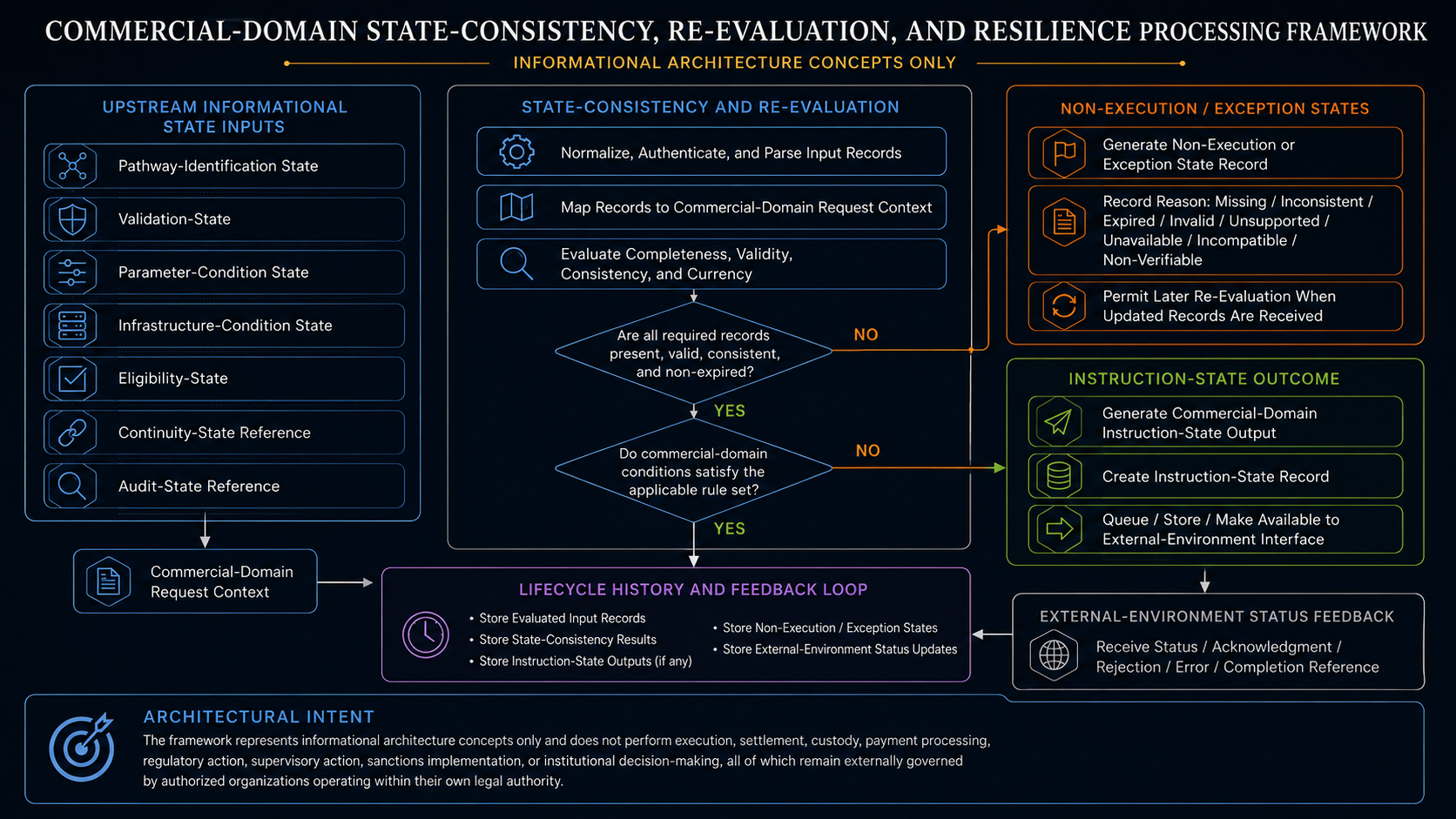
Illustrative architecture concept only. The diagram does not represent operational deployment, legally operative transaction execution, payment processing, custody, settlement, regulatory authority, or institutional adoption.
02 — CUSTODY-SUPPORT FAMILY
FiVaultAI™
Lifecycle-Separated Custody-Support Architecture
FiVaultAI™ presents custody-support architecture organized around separately bounded asset-environment representation, custody-state representation, access-state references, cryptographic-key lifecycle references, release-condition representation, release-gate state generation, and audit-oriented traceability.
Each function remains confined to an informational architecture role. The framework supports structured state readability across independently governed custody environments without possessing assets, controlling customer property, making custody decisions, originating release authority, transferring assets, or performing downstream institutional action.
Framework Components
FiVaultAI™
Custody-Support and Asset-Environment State Representation
A lifecycle-separated framework for representing custody-related information, asset-environment states, access references, and reviewable lifecycle records without possessing, safeguarding, transferring, or controlling customer assets.
Release-Gating Architecture
Release-Condition Representation and Release-Gate State Generation
A separately bounded component for representing externally established release conditions and generating release-gate states without making release decisions, releasing assets, initiating transfers, controlling custody, or performing downstream execution.
Official Trademark Record
FiVaultAI™
U.S. Trademark Application Serial No. 99461716
Patent Architecture Continuity
U.S. Patent Application No. 19/567,140
Custody-Support and Asset-Environment Representation Architecture
Represents separately bounded asset-environment states, custody-related states, access-state references, cryptographic-key lifecycle references, and reviewable custody-support records. The architecture does not provide custody services, possess or control customer assets, administer escrow, determine identity, transfer assets, or perform institutional execution.
U.S. Patent Application No. 19/572,259
Release-Gate State Generation Architecture
Represents externally established release conditions and generates a bounded release-gate state. Release-gate state generation does not originate authorization, make a custody decision, release or transfer assets, control customer property, or perform downstream institutional action.
Related Architecture Layers
Asset-Environment Representation
Informational representation of asset-related environments and lifecycle conditions without possession, safeguarding, transfer, or control.
Custody-State Representation
Representation of custody-related states without providing custody or controlling assets.
Access-State References
Representation of externally established access-related references without determining identity, eligibility, or authorization.
Cryptographic-Key Lifecycle References
Representation of key-related lifecycle states without possessing keys or exercising operational key control.
Escrow-Environment State Representation
Representation of escrow-related states without holding funds, administering escrow, or controlling release.
Release-Condition Representation
Representation of externally established release conditions without creating authorization or making release decisions.
Release-Gate State Generation
Generation of a bounded release-gate state without releasing assets, initiating transfers, or performing downstream execution.
Audit-Oriented Traceability
Reviewable custody-support lifecycle records without performing an audit, exercising supervision, or making compliance determinations.
Custody-Support Separation Principle
Asset-state representation is not asset control.
Custody-state representation is not custody.
Access-state representation is not identity or eligibility determination.
Cryptographic-key lifecycle representation is not operational key control.
Escrow-state representation is not escrow administration.
Release-condition representation is not authorization.
Release-gate state generation is not release execution.
Audit-oriented traceability is not supervision.
Interoperability is not institutional integration.
Architecture is not authority.
Custody-Support Boundary
VeloxVFX LLC and FiVaultAI™ present lifecycle-separated informational custody-support architecture concepts. They do not provide custody services, possess or control customer assets, safeguard customer funds, manage reserves, administer escrow, determine identity or eligibility, originate authorization, make release decisions, release or transfer assets, execute transactions, process payments, transmit money, or conduct settlement.
The architecture does not issue currency, stablecoins, deposits, securities, investment products, or financial instruments. It does not make legally operative compliance determinations, exercise supervisory or enforcement authority, replace official custody records, or perform downstream institutional action.
All custody, asset control, identity and eligibility determinations, authorization, release decisions, transfers, payment processing, settlement, compliance determinations, and governmental functions remain with independently authorized organizations acting within their respective authority.
Presentation of this architecture does not imply affiliation, adoption, endorsement, approval, procurement, implementation, institutional integration, or operational use by any government, agency, financial institution, custodian, market infrastructure, technology provider, or other organization.
Custody-Support Lifecycle Separation
Visual Caption
Conceptual representation of separately bounded custody-support and release-gate states. The visual does not represent custody services, asset possession or control, escrow administration, asset transfer, payment processing, settlement, institutional deployment, or authority exercised by VeloxVFX LLC.
03 — TRANSACTION-ENVIRONMENT FAMILY
BidGoCoin™ / BDGO
Lifecycle-Separated Bidding and Transaction-Environment Architecture
BidGoCoin™ / BDGO presents transaction-environment architecture organized around separately bounded bidding-environment representation, participant-state references, offer-state representation, acceptance-state representation, escrow-environment references, transaction-state continuity, and audit-oriented traceability.
Each function remains confined to an informational architecture role. The framework supports structured state readability across independently governed transaction environments without operating a marketplace, conducting auctions, accepting or holding customer funds, administering escrow, controlling assets, executing transactions, processing payments, transmitting money, or conducting settlement.
Framework Components
BidGoCoin™
Bidding-Environment and Transaction-State Representation
A lifecycle-separated framework for representing bidding-related states, transaction-environment information, and reviewable event sequences without operating a bidding platform, conducting auctions, executing transactions, or controlling participant assets.
BDGO
Non-Settlement Transaction-Environment Architecture
A separately bounded architecture for representing bidding and transaction-environment states while preserving separation from payment processing, money transmission, custody, escrow administration, legally operative execution, and settlement.
Official Trademark Record
BidGoCoin™
U.S. Trademark Application Serial No. 99278288
Patent Architecture Continuity
U.S. Patent Application No. 19/273,793
Non-Settlement Bidding and Transaction-Environment Representation Architecture
Represents separately bounded bidding-environment states, participant-state references, offer and acceptance-state information, escrow-environment references, and transaction-state continuity. The architecture does not operate a marketplace, conduct bidding activity, accept or hold funds, administer escrow, transfer assets, process payments, transmit money, execute settlement, or determine legally operative contractual outcomes.
Related Architecture Layers
Bidding-Environment Representation
Representation of bidding-related environments without operating a bidding platform or conducting an auction.
Participant-State References
Representation of externally established participant-related references without determining identity, eligibility, or legal capacity.
Offer-State Representation
Representation of offer-related lifecycle information without creating, submitting, or making an offer.
Acceptance-State Representation
Representation of externally attributable acceptance-state information without creating contractual acceptance or determining legal effect.
Transaction-State Representation
Lifecycle-separated representation of transaction-related information without legally operative transaction execution.
Escrow-Environment State References
Representation of escrow-related states without accepting funds, holding assets, administering escrow, or controlling release.
Continuity-Oriented Coordination
Representation of state continuity across independently governed transaction environments without controlling participant action.
Audit-Oriented Traceability
Reviewable transaction-environment event records without performing an audit, exercising supervision, or making compliance determinations.
Transaction-Environment Separation Principle
Bidding-state representation is not bidding-platform operation.
Participant-state reference is not identity or eligibility determination.
Offer-state representation is not offer creation.
Acceptance-state representation is not legally operative acceptance.
Transaction-state representation is not transaction execution.
Escrow-state representation is not escrow administration.
Continuity is not control.
Audit-oriented traceability is not supervision.
Interoperability is not institutional integration.
Architecture is not authority.
Transaction-Environment Boundary
VeloxVFX LLC, BidGoCoin™, and BDGO present lifecycle-separated informational transaction-environment architecture concepts. They do not operate a marketplace, auction platform, exchange, broker, payment service, escrow service, custody service, clearing organization, or settlement system.
The architecture does not accept or hold customer funds, control assets, administer escrow, determine identity or eligibility, create offers or contractual acceptance, execute transactions, process payments, transmit money, conduct settlement, or determine legally operative outcomes. It does not issue currency, stablecoins, deposits, securities, investment products, or financial instruments.
All bidding activity, participant determinations, offer and acceptance actions, contractual decisions, escrow administration, custody, transfers, payment processing, execution, and settlement remain with independently authorized organizations and participants acting within their respective authority.
Presentation of this architecture does not imply affiliation, adoption, endorsement, approval, procurement, implementation, institutional integration, or operational use by any government, agency, financial institution, marketplace, market infrastructure, technology provider, or other organization.
Bidding and Transaction-Environment Lifecycle Separation
Visual Caption
Conceptual representation of separately bounded bidding and transaction-environment states. The visual does not represent marketplace operation, auction administration, escrow services, custody, payment processing, money transmission, settlement, institutional deployment, or authority exercised by VeloxVFX LLC.
04 — GOVERNMENT-FACING CONTINUITY FAMILY
USDCC™ / USDCR™
Government-Facing Lifecycle-Separated Continuity Architecture
USDCC™ / USDCR™ presents government-facing informational architecture organized around separately bounded continuity-state representation, externally governed authorization-state references, value-state readability, time-state representation, threshold-state references, legal- and identity-reference states, externally authorized control-context representation, and audit-oriented traceability.
Each function remains confined to its own lifecycle role. The architecture supports structured state readability across independently governed public and institutional environments without originating governmental authority, issuing currency, administering monetary policy, determining legal status, controlling value, performing sanctions or enforcement functions, executing transactions, providing custody, or conducting settlement.
Framework Components
USDCC™
Government-Facing Continuity-State Representation
A lifecycle-separated framework for representing continuity-related states across independently governed public and institutional environments without issuing currency, originating governmental authority, or exercising sovereign control.
USDCR™
Government-Facing Continuity and Audit-State Record Architecture
A separately bounded framework component supporting continuity-oriented, reviewable state records without regulatory reporting, supervision, enforcement, sanctions administration, or governmental decision-making.
USDCC T-Bill™
Treasury-Environment Reference-State Architecture
A conceptual component for representing externally governed Treasury-environment reference states without issuing securities, managing reserves, providing investment products, generating financial returns, controlling liquidity, or conducting settlement.
Official Trademark Records
USDCC™
U.S. Trademark Application Serial No. 99346460
U.S. Trademark Application Serial No. 99417388
USDCR™
U.S. Trademark Application Serial No. 99535278
USDCC T-Bill™
U.S. Trademark Application Serial No. 99424961
Patent Architecture Continuity
U.S. Patent Application No. 19/304,431
Government-Facing Decision- and Distribution-State Representation Architecture
Represents externally generated, externally authorized, or externally attributable decision and distribution states within a separately bounded government-facing architecture. It does not originate governmental decisions, distribute public funds, determine legal entitlement, create authorization, or exercise public authority.
U.S. Patent Application No. 19/321,283
Government-Facing Infrastructure-State Readability Architecture
Represents infrastructure and continuity-related information in an agency-readable or institutionally reviewable form. Infrastructure-state readability does not perform supervision, make compliance determinations, determine policy, enforce requirements, or control institutional infrastructure.
U.S. Patent Application No. 19/310,864
Externally Authorized Control-Context Representation Architecture
Receives, represents, preserves, and makes externally authorized control context available within a separately bounded lifecycle function. It does not originate commands, create governmental authority, determine policy, or independently direct institutional action.
U.S. Patent Application No. 19/276,661
Externally Commanded Deterministic State-Transition Architecture
Represents a bounded deterministic state transition following receipt of an externally generated command. It does not originate the command, determine legal authority, establish governmental policy, make sovereign decisions, or independently authorize downstream institutional action.
U.S. Patent Application No. 19/572,075
USDX Continuity-State Representation Architecture
Represents separately bounded value, transaction, timing, threshold, identity-reference, legal-reference, review, and agency-readable continuity states. Continuity-state representation does not calculate margin, approve offsets, control collateral, set thresholds, determine identity, make legal determinations, block or freeze value, execute transactions, authorize action, redeem value, or conduct settlement.
Government-Facing Continuity-State and Institutional-Boundary Architecture
This conceptual architecture illustrates how externally governed or externally supplied references may be represented through separately bounded continuity-state, decision-state, distribution-state, authorization-state, infrastructure-readability, control-context, time-state, threshold-state, value-state, legal-reference, identity-reference, and audit-oriented traceability functions.
Each function remains confined to an informational representation role. USDCC™ / USDCR™ does not originate governmental authority, establish policy, make institutional decisions, determine legal status or eligibility, issue commands, direct institutional action, or exercise operational control.
Represented states may be made available within independently governed review environments for continuity, readability, and traceability purposes. Any institutional decision, authorization, execution, reporting, enforcement, payment, custody, transfer, clearing, settlement, or other operative action remains external to the USDCC™ / USDCR™ representation boundary.
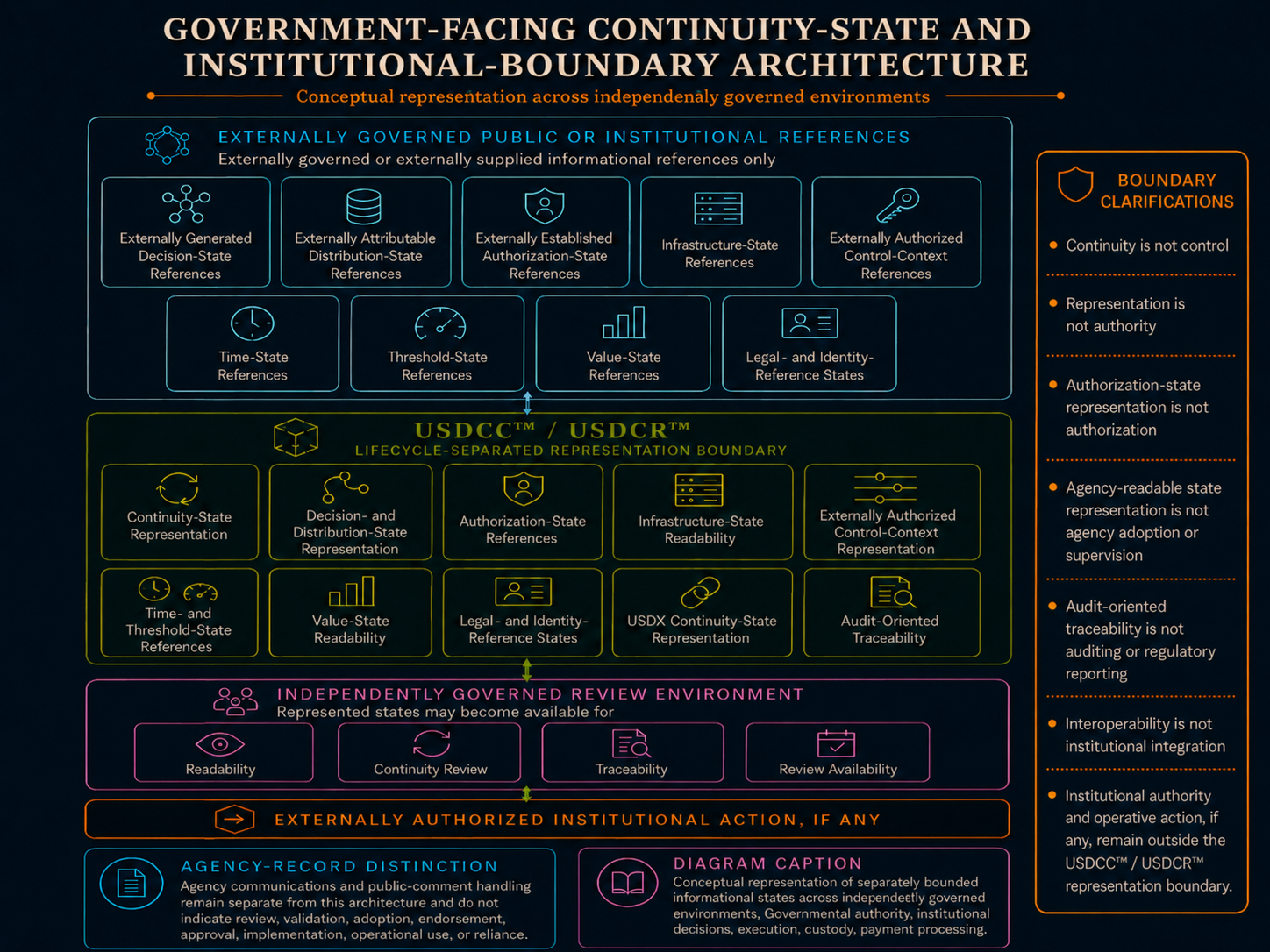
Conceptual USDCC and USDCR continuity-state, institutional-boundary, independent-review, and externally authorized action architecture.
Agency-Record Distinction
VeloxVFX LLC has submitted informational architecture materials through available public-comment and agency communication channels. Any acknowledgment, routing guidance, procedural communication, or public-comment handling by an agency remains separate from the architecture presented here and does not indicate substantive review, validation, adoption, endorsement, approval, procurement, implementation, institutional integration, operational use, or reliance.
Visual Caption
Conceptual representation of separately bounded informational states across independently governed environments. Governmental authority, institutional decisions, execution, custody, payment processing, money transmission, clearing, and settlement remain external to the USDCC™ / USDCR™ representation boundary.
Government-Facing Architecture Boundary
USDCC™ / USDCR™ presents lifecycle-separated, government-facing continuity and reference-state architecture concepts. The architecture does not constitute government infrastructure, a monetary system, a payment service, a regulatory-reporting system, an enforcement mechanism, a sanctions-administration system, a custody service, a clearing organization, or a settlement system.
VeloxVFX LLC does not originate governmental authority, issue currency, establish public policy, determine legal rights or entitlements, determine identity or eligibility, authorize institutional action, generate legally operative commands, direct governmental activity, exercise supervision or enforcement, administer sanctions, control assets or value, execute transactions, process payments, transmit money, provide custody, conduct clearing, or perform settlement.
All governmental authority, institutional decision-making, authorization, execution, reporting, supervision, enforcement, sanctions administration, custody, payment processing, clearing, settlement, and other operative activity remain with independently authorized institutions acting within their respective legal and operational authority.
Presentation of this architecture does not imply affiliation, recognition, substantive agency review, adoption, endorsement, approval, procurement, implementation, institutional integration, operational use, or reliance by any government, agency, central bank, financial institution, market infrastructure, technology provider, or other organization.
Related Architecture Layers
Continuity-State Representation
Representation and preservation of continuity-related states without operational control or institutional authority.
Authorization-State References
Representation of externally established authorization states without originating or granting authorization.
Value-State Readability
Informational representation of value-related states without currency issuance, redemption, transfer, exchange operation, or value control.
Time-State Representation
Representation of externally established timing conditions and review periods without creating legal deadlines or requirements.
Threshold-State References
Representation of externally governed thresholds without setting limits or making reporting, eligibility, or enforcement determinations.
Legal- and Identity-Reference States
Representation of externally supplied legal and identity-related references without determining identity, eligibility, entitlement, or legal status.
Externally Authorized Control-Context Representation
Representation and preservation of externally authorized control context without originating governmental authority or commands.
Deterministic State-Transition Processing
Bounded processing following an externally generated command without independent policy, authority, or legal-decision origination.
Audit-Oriented Traceability
Reviewable government-facing lifecycle records without regulatory reporting, supervision, enforcement, sanctions authority, or replacement of official records.
Government-Facing Separation Principle
Continuity is not control.
Authorization-state representation is not authorization.
Decision-state representation is not governmental decision-making.
Distribution-state representation is not the distribution of public funds.
Value-state readability is not currency issuance, redemption, or value control.
Time-state representation does not establish legal time periods.
Threshold-state representation does not set legal thresholds.
Identity-reference representation is not identity or eligibility determination.
Control-context representation is not sovereign decision-making.
Deterministic state-transition processing does not originate governmental authority.
Audit-oriented traceability is not supervision or regulatory reporting.
Interoperability is not institutional integration.
Architecture is not authority.
Government-Facing Continuity-State Separation
Visual Caption
Conceptual representation of separately bounded, externally governed continuity and reference states. The visual does not represent governmental adoption, currency issuance, monetary authority, supervision, enforcement, sanctions administration, payment processing, custody, settlement, institutional deployment, or authority exercised by VeloxVFX LLC.
Cross-Family Separation Principle
The four VeloxVFX architecture families remain independently bounded according to their respective domains and principal lifecycle functions.
Commercial-domain instruction-state generation is not custody-support architecture.
Custody-state representation is not transaction-environment operation.
Transaction-environment representation is not governmental continuity architecture.
Government-facing continuity-state representation is not sovereign authority.
Routing is not validation.
Evaluation is not routing.
Parameter conditioning is not authorization.
Instruction-state generation is not legally operative institutional execution.
Continuity is not control.
Release gating is not release execution.
Audit-oriented traceability is not supervision.
Structured interoperability does not consolidate institutional authority.
Architecture is not authority.
Public-Record Reference Notice
References to patent applications, trademark records, governmental materials, public comments, agency publications, or other public records are provided for informational and architecture-oriented identification only.
A public filing or correspondence record does not establish agency access, awareness, influence, causation, reliance, affiliation, adoption, endorsement, approval, procurement, implementation, operational integration, patent validity, patent enforceability, legal equivalence, or infringement.
Official governmental and USPTO records remain authoritative. Application numbers identify pending or publicly available records and do not represent the issuance of a patent, final agency determination, or governmental validation of the architecture.
Global Boundary Statement
VeloxVFX LLC presents lifecycle-separated informational architecture concepts. VeloxVFX LLC is not a bank, financial institution, payment processor, money transmitter, settlement operator, custodian, stablecoin issuer, exchange, broker, clearing organization, governmental authority, regulatory authority, supervisory authority, enforcement authority, sanctions authority, or sovereign monetary authority.
The architecture does not independently execute transactions, control assets, determine identity or eligibility, originate institutional authorization, make legally operative compliance determinations, establish governmental policy, or determine legal or regulatory outcomes.
All legally operative decisions, authorization, execution, payment processing, settlement, custody, compliance determinations, supervision, enforcement, sanctions administration, and governmental functions remain with independently authorized organizations acting within their respective authority.
VeloxVFX LLC does not provide financial, legal, tax, regulatory, compliance, or investment advice. Presentation of these concepts does not imply affiliation, adoption, endorsement, approval, procurement, implementation, institutional integration, or operational use by any government, agency, financial institution, market infrastructure, technology provider, or other organization.
The objective is not consolidation.
The objective is structured coordination.