

Lifecycle-Separated Architecture
Architecture for Interoperability, Continuity, and Institutional-Boundary Preservation
Architecture Interpretation
The following interpretation describes the conceptual scope, architectural boundaries, and intended reading of the VeloxVFX architecture. It explains how the framework is intended to be understood within independently governed operational environments and how it preserves the distinction between informational representation and operational authority.
Conceptual Architecture Overview
VeloxVFX architecture is organized around lifecycle-separated coordination, continuity-oriented modernization, structured interoperability, supervisory readability, audit-oriented traceability, and institutional-boundary preservation across heterogeneous operational environments.
The architecture is presented as an informational, non-executing framework for representing operational states and relationships while preserving the independent authority of the institutions responsible for execution, settlement, custody, compliance, supervision, and enforcement.
System Placement and Operational Boundary Context
The VeloxVFX architecture should be understood as a conceptual, non-executing state-representation and reviewability layer positioned relative to externally governed operational environments.
Architectural Interpretation
For purposes of this publication:
Government-facing describes compatibility with public-authority environments and does not imply governmental adoption, endorsement, or operation.
Supervisory readability refers to informational visibility that supports review and understanding of represented states. It does not imply regulatory access, regulatory authority, supervisory control, or decision-making.
Continuity refers to informational preservation and traceability of represented states. It does not imply settlement finality, legal finality, redemption, or operational availability.
Reserve-context representation refers solely to informational representation of reserve-related states and relationships. It does not imply custody, investment, management, allocation, encumbrance, or redemption of reserve assets.
In real-world institutional settings, payment systems, custody systems, settlement environments, banking systems, supervisory systems, compliance systems, and internal enterprise systems remain independently governed by their respective organizations and authorities. VeloxVFX does not replace, operate, control, or integrate into those systems.
The architecture may be described as supporting conceptual review of how externally governed state information could be represented, organized, reviewed, or mapped for continuity, auditability, supervisory readability, exception awareness, re-evaluation, or institutional-boundary clarity.
VeloxVFX outputs should be understood as informational state representations only. They do not move funds, alter balances, approve transactions, reject transactions, initiate execution, trigger settlement, control custody, transmit money, perform payment processing, impose compliance decisions, make regulatory determinations, exercise supervisory authority, exercise enforcement authority, exercise sanctions authority, or control independently governed operational systems.
Any execution, settlement, custody, payment processing, account action, institutional approval, institutional rejection, regulatory determination, supervisory determination, enforcement determination, sanctions action, or operational deployment remains external to VeloxVFX and subject to independently governed organizations acting within their own authority, responsibility, and legal obligations.
Lifecycle-Separated Continuity and Interoperability Model
This model illustrates the conceptual placement of VeloxVFX relative to independently governed operational environments. It presents VeloxVFX as a non-executing informational and reviewability layer supporting continuity representation, supervisory readability, audit-oriented traceability, and structured interoperability across separately governed institutions and systems.
The model does not represent an operational system, service offering, implementation requirement, or transaction-processing environment. Execution, settlement, custody, payment processing, regulatory determinations, supervisory actions, sanctions decisions, enforcement actions, and institutional approvals remain external to VeloxVFX and under the authority of the applicable institution, governmental body, agency, or authorized organization.
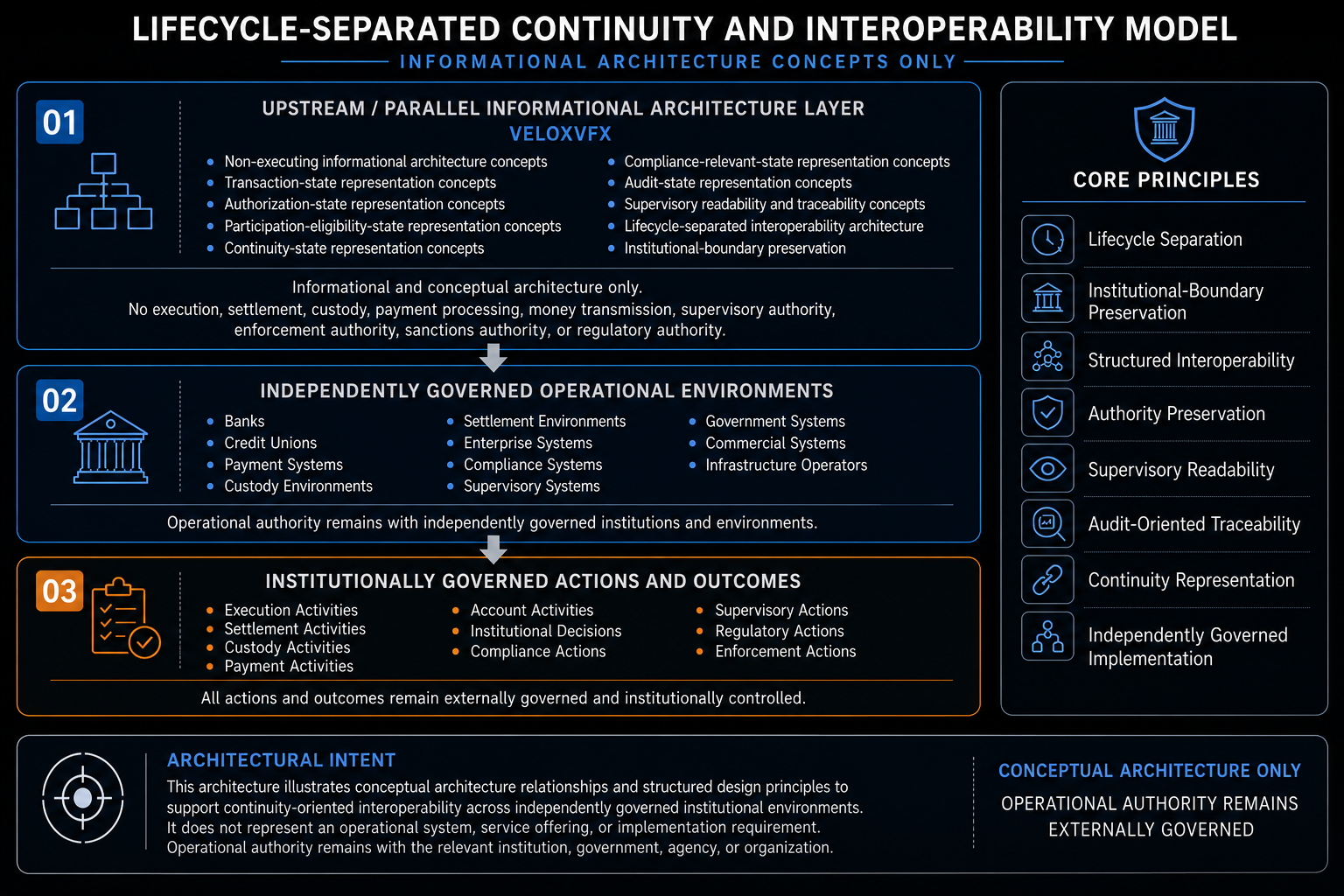
This diagram illustrates the conceptual placement of VeloxVFX relative to independently governed operational environments. VeloxVFX is presented as a non-executing state-representation and reviewability layer. It does not move funds, alter balances, initiate execution, trigger settlement, provide custody, process payments, transmit money, or exercise regulatory, supervisory, enforcement, or sanctions authority. Operational actions and decisions remain external to VeloxVFX and subject to independently governed organizations acting within their own authority and responsibility.
Lifecycle-Separated Coordination Architecture
A conceptual coordination framework illustrating lifecycle-separated routing-state, validation-state, parameter-conditioning, execution-control-state, continuity-state, and audit-oriented observability layers. The framework is intended to show how distinct informational states may be represented and related across independently governed environments without merging their functions or transferring operational authority.
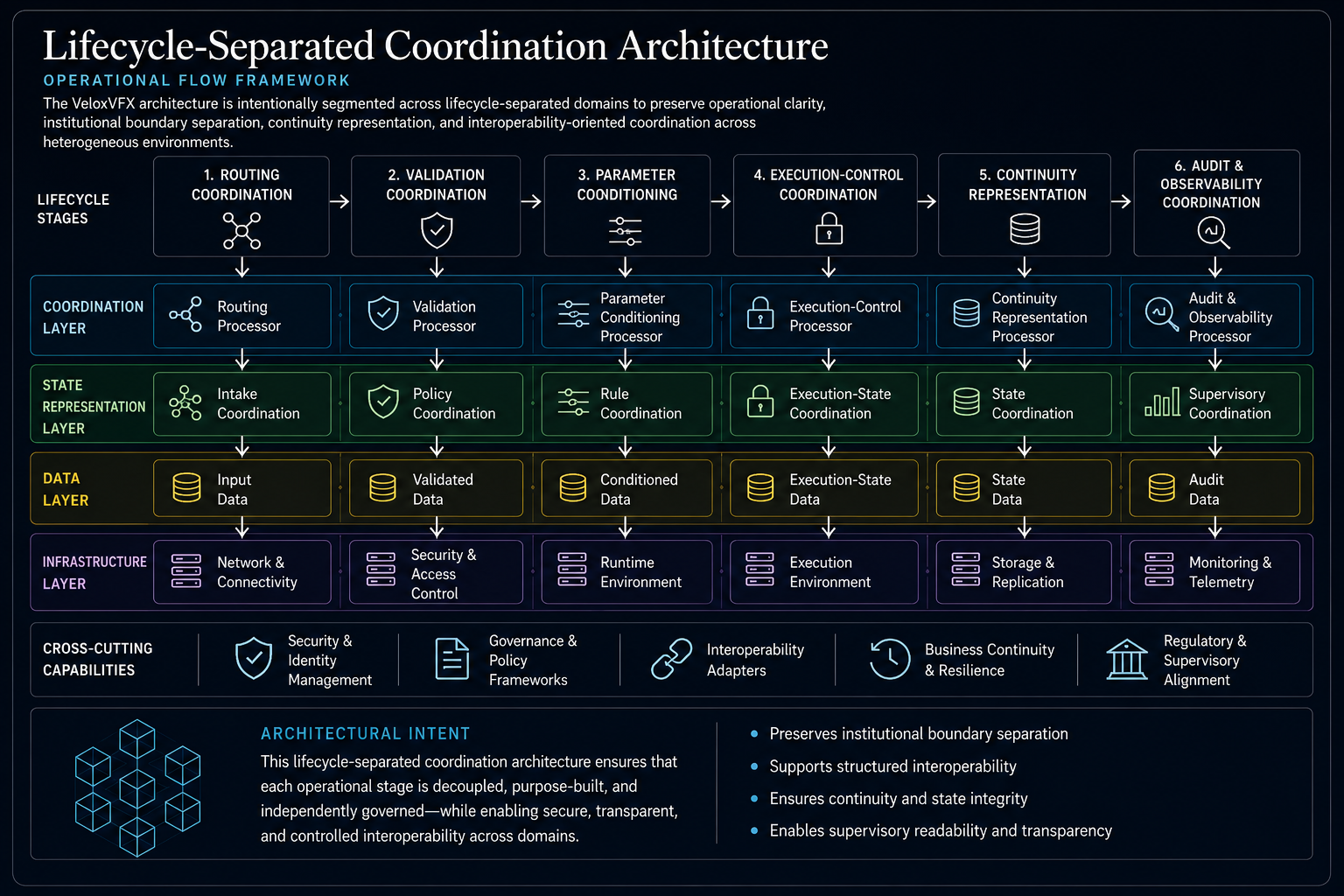
This diagram illustrates lifecycle-separated coordination concepts across routing-state representation, validation-state representation, parameter-conditioning representation, transaction-state representation, continuity representation, and audit-oriented observability. The diagram is presented as a conceptual architecture reference only and does not represent execution, settlement, custody, payment processing, money transmission, regulatory authority, supervisory authority, enforcement authority, sanctions authority, or operational control.
Operational Boundary Preservation Architecture
A conceptual boundary-preservation framework illustrating how commercial, government-facing, custody, supervisory, infrastructure, and continuity domains may remain functionally distinct and independently governed while being represented through structured interoperability concepts. The framework is intended to support continuity, observability, and reviewability without merging institutional responsibilities, transferring authority, or implying operational integration.
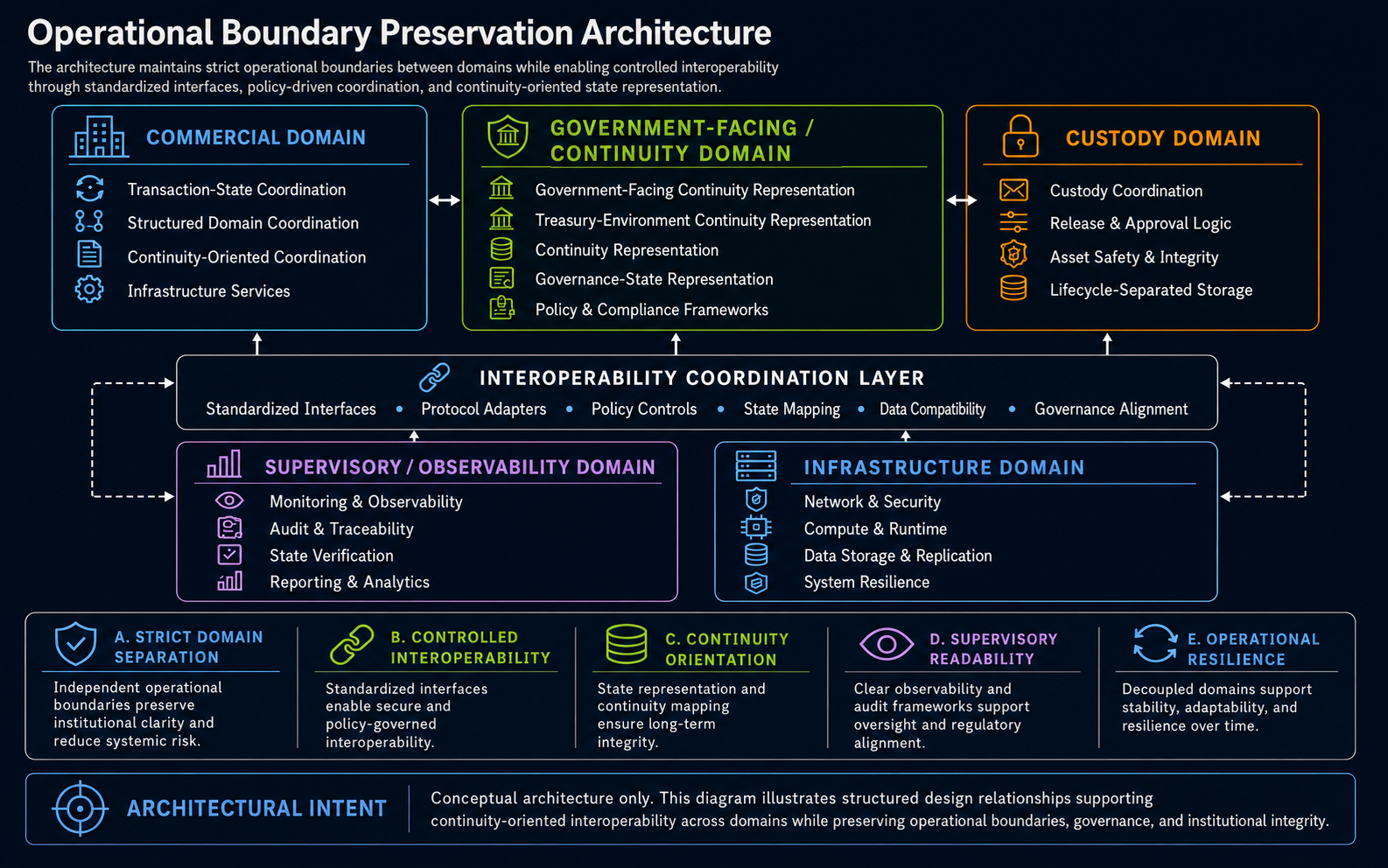
This diagram illustrates how distinct commercial, government-facing, custody, supervisory, continuity, infrastructure, and observability domains may be represented through structured interoperability concepts while remaining independently governed. It is intended to show institutional-boundary preservation, domain separation, supervisory readability, and continuity-oriented coordination without implying institutional consolidation, operational integration, agency adoption, or replacement of independently governed systems.
Lifecycle-Separated Framework and Domain Map
A conceptual framework and domain map illustrating how named VeloxVFX architecture families may be positioned across independently governed commercial, government-facing, custody, supervisory, infrastructure, and continuity-oriented environments. The map is intended to show structured relationships and domain separation without implying operational integration, transfer of authority, agency adoption, or performance of regulated functions.
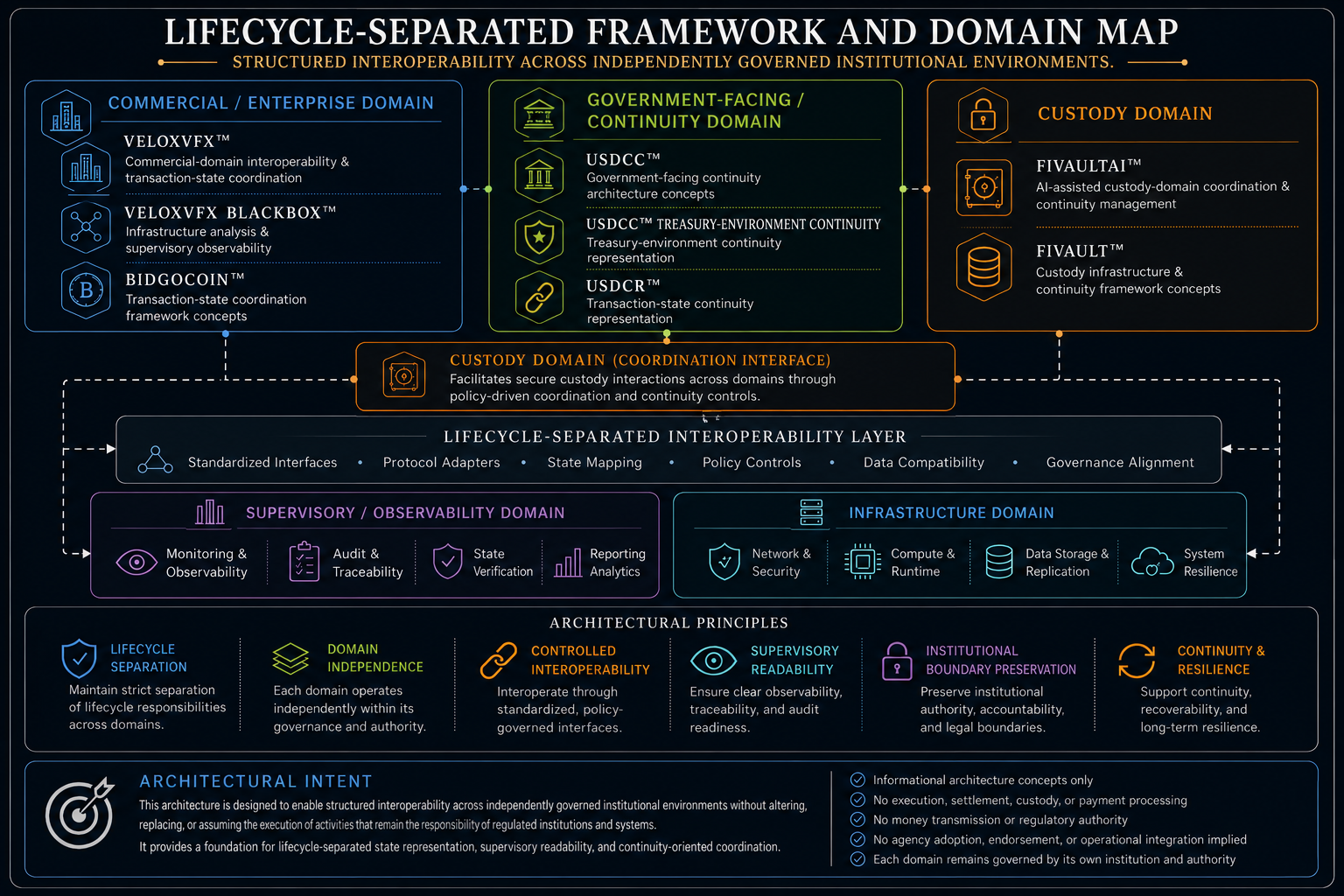
This diagram presents a conceptual domain map of lifecycle-separated architecture families within the VeloxVFX framework. It illustrates how commercial-domain, custody-support, government-facing continuity, supervisory, and observability concepts may be represented through a structured interoperability layer. It does not imply agency adoption, institutional adoption, operational deployment, custody, settlement, payment processing, money transmission, stablecoin issuance, or financial-service activity.
Diagram Boundary Statement
These architecture diagrams are presented as conceptual architecture references only. They do not represent an operational system, service offering, implementation requirement, institutional adoption, agency adoption, endorsement, procurement, operational integration, custody, settlement, payment processing, money transmission, stablecoin issuance, sovereign or governmental authority, regulatory authority, supervisory authority, enforcement authority, sanctions authority, account action, institutional decision-making, customer-asset control, or financial-service activity.
Commercial-Domain Instruction-State Architecture
This architecture illustrates how upstream lifecycle-separated state records may be evaluated within a processor-defined commercial-domain framework to generate informational instruction-state outputs, non-execution and exception-state records, re-evaluation states, reconciliation references, and an audit-oriented lifecycle history.
The architecture does not perform transaction execution, settlement, custody, payment processing, money transmission, sanctions determinations, regulatory or supervisory decisions, enforcement actions, or institutional approvals. All operational actions, legal determinations, and implementation decisions remain external to VeloxVFX and under the authority of independently governed institutions, systems, agencies, and authorized organizations.
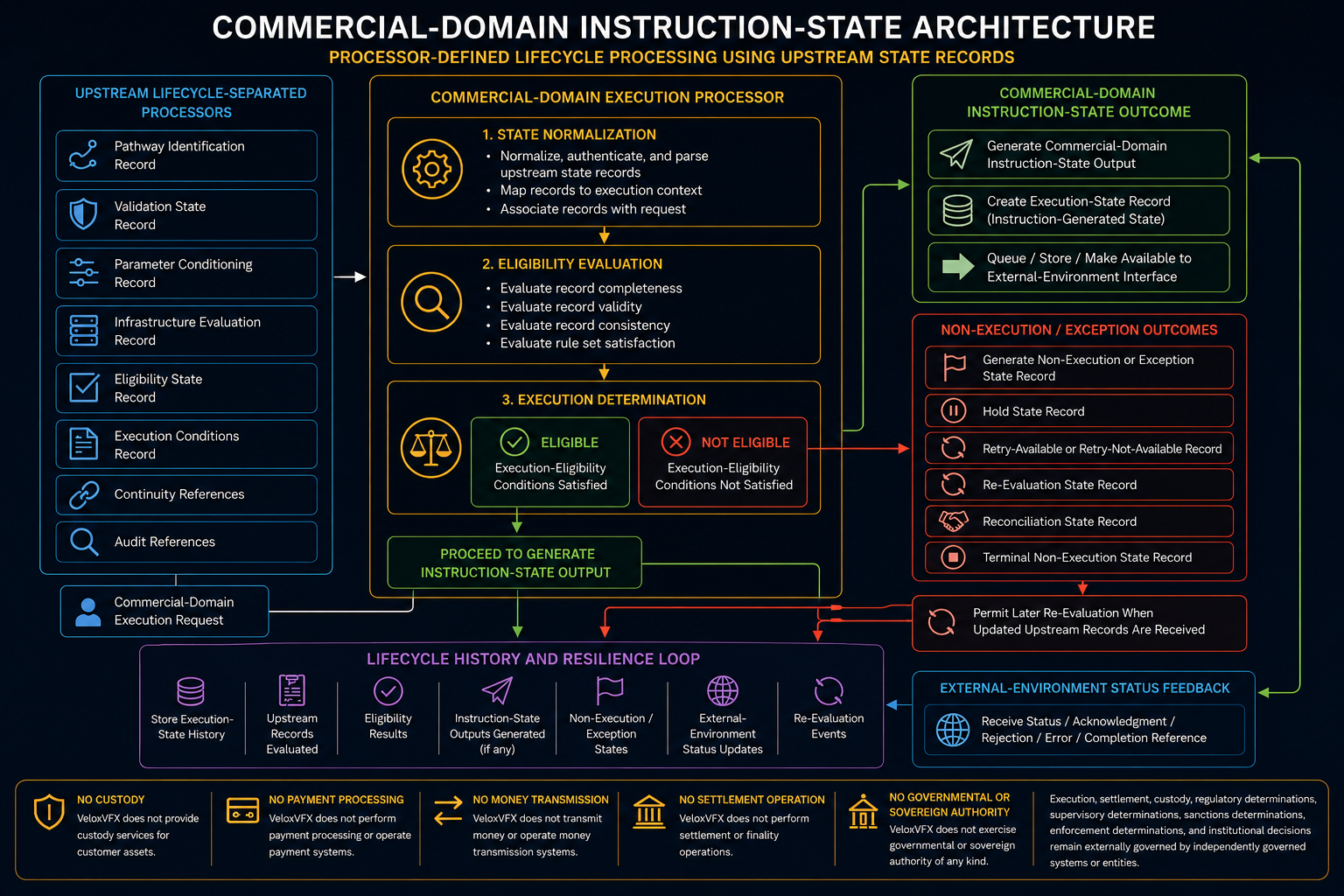
This diagram illustrates a processor-defined commercial-domain instruction-state architecture operating on upstream lifecycle-separated state records. The architecture may be described as evaluating processor-readable state information and generating informational commercial-domain instruction-state outputs, non-execution state records, exception outcomes, re-evaluation states, and audit-oriented lifecycle history. Execution, settlement, custody, account action, regulatory determinations, supervisory determinations, sanctions determinations, enforcement determinations, and institutional decisions remain externally governed by independently governed systems or entities.
Conceptual commercial-domain state-consistency, re-evaluation, resilience, and externally governed execution-status architecture.
Architecture Closing Statement
The VeloxVFX architecture is presented as a lifecycle-separated interoperability framework for conceptual state representation, continuity-oriented review, supervisory readability, audit-oriented traceability, and institutional-boundary preservation.
Across each architecture reference, operational authority remains external. Execution, settlement, custody, payment processing, account action, institutional approval or rejection, regulatory determinations, supervisory determinations, enforcement actions, sanctions actions, implementation decisions, and operational deployment remain subject to independently governed organizations acting within their own authority, responsibility, and legal obligations.
The purpose of the architecture is not to consolidate authority, replace institutions, operate financial infrastructure, or create dependency on a single system. The purpose is to clarify how distinct lifecycle domains may be represented, reviewed, and discussed through structured interoperability while preserving independently governed operational boundaries.